
Youth STEAM Academy
The "Youth STEAM Academy" project, implemented by the Zamolxes Foundation between October 16-23, 2024, brought together 24 participants from six countries in Câmpina. Co-funded by Erasmus+, this mobility enhanced youth leaders' STEAM education competencies, using non-formal methods to foster innovation, creativity, and critical thinking within European communities.
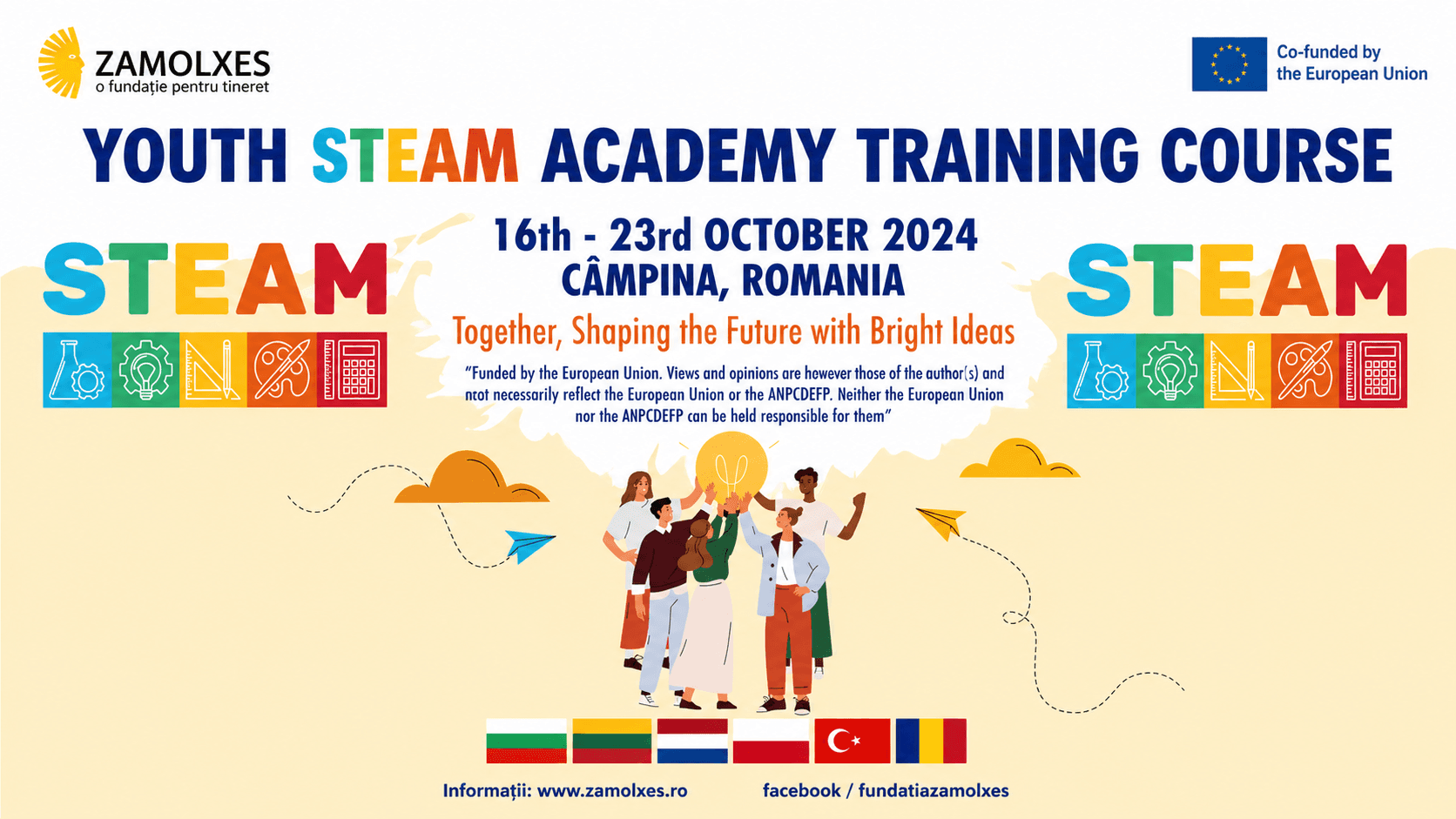
October 16-23 2024
The Zamolxes Foundation implemented the "Youth STEAM Academy" project, an Erasmus+ youth mobility, from October 16–23, 2024, at the Zamolxes Youth Cultural Center in Câmpina. The event brought together 24 participants, two trainers, and two facilitators from Bulgaria, Lithuania, the Netherlands, Poland, Turkey, and Romania.
The aim of the project was to develop the STEAM (Science, Technology, Engineering, Arts, and Mathematics) competencies of the 24 participants, encouraging innovation, creativity, and problem-solving among youth in their communities.
Project Objectives:
- Equipping youth leaders with a comprehensive understanding of STEAM education and its role in promoting interdisciplinary learning.
- Highlighting the importance of integrating arts into STEAM to foster creativity and holistic learning.
- Developing leadership, communication, and facilitation skills necessary for guiding youth in STEAM activities.
- Enhancing problem-solving, critical thinking, and collaboration skills among youth leaders, enabling them to model these skills for their peers.
- Training youth leaders in designing and implementing STEAM-based programs and activities tailored to the interests and needs of young people in their communities.
The project was based on non-formal education concepts, including icebreakers, teambuilding activities, workshops, seminars, meetings, discussions, integration activities, presentations, and hands-on learning activities, all connected to the project theme. The training course was delivered by two trainers and two facilitators with extensive experience in STEAM and non-formal education.
The project was co-funded by the European Commission through the Erasmus+ Program.